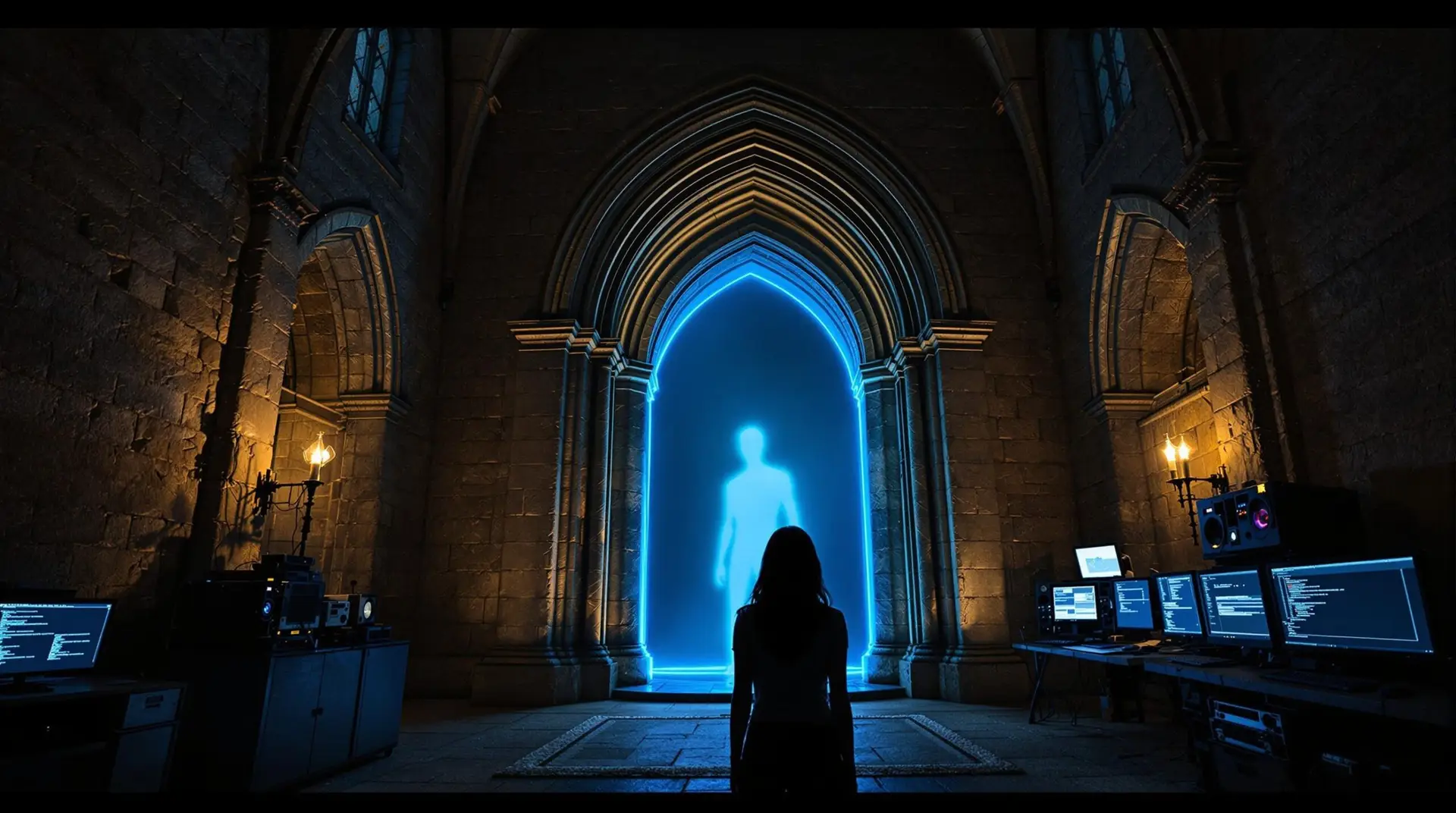
The Cambridge Science Park sprawled across the city’s northern edge, its glass and steel structures housing Britain’s brightest technological minds, all abuzz with experiments, simulations, and the development of the Ghost Algorithm. Dr. Elizabeth Winters stared at her monitor, blue light carving shadows across her face as her desk clock ticked past midnight. Beyond her window, Cambridge University’s ancient spires pierced the night sky—silent sentinels bearing witness to her cutting-edge work just as they had centuries of scholarship before.
“Run simulation 42-B,” she said, her voice falling into the silence of the empty Lumina AI office. The neural network visualization pulsed with life—connections forming, strengthening, and dissolving as her algorithm mapped emotional patterns. She watched for the subtle transitions her code couldn’t quite capture.
Elizabeth pressed her fingertips against tired eyes. Six months at this startup had produced remarkable advances in her conversational AI, but tonight, something felt off in the code. Or perhaps something felt off in her. The anniversary of Tom’s death loomed just three days away.
Her gaze drifted to the framed photo on her desk—Elizabeth and Tom on a punt on the River Cam, his arm around her shoulders, both laughing. Dr. Thomas Reed, theoretical physicist and her partner of eight years, vanished in an instant when his heart simply stopped one morning. Thirty-six years old. No warning. No goodbye. Somewhere in his research notes, she remembered, lay the encrypted framework of The Ghost Algorithm.
Her phone buzzed with a message.
Working late again? Don’t forget our lunch tomorrow. – James
Dr. James Sullivan, her former doctoral advisor, was still keeping tabs on her wellbeing. Elizabeth felt a faint smile cross her lips but set her phone aside without replying. Sullivan’s concern was genuine, but recently, his ethical cautions about her research felt suffocating. Their last conversation had become heated when she mentioned her work on personality simulation.
“These grief simulators cause more harm than good, Liz,” he’d argued. “People need to process loss, not create digital phantoms.”
She had insisted that her research focused on enhancing conversational flow in AI rather than on creating facsimiles of the dead. And that was true—at the time.
The simulation results appeared on her screen: 87% emotional congruence. Good, but not great. The algorithm still couldn’t capture the subtle emotional shifts that made human conversations feel natural. It was missing something essential.
Elizabeth’s attention drifted to her personal laptop, where she had been archiving Tom’s digital footprint: emails, text messages, research papers, videos of his lectures, social media posts, and voice recordings. All meticulously organized—ostensibly for memorial purposes, though she rarely examined any of it. The pain remained too raw. Yet buried deep among the files, a folder marked The Ghost Algorithm seemed to hum with unfinished work.
A thought surfaced, dangerous and tempting.
“What if…” she murmured to the empty room.
She was the leading researcher in emotional pattern recognition in AI. Tom had been a theoretical physicist specializing in quantum information states. Their late-night discussions on consciousness and information had pushed the boundaries of both their fields. What if she applied The Ghost Algorithm to Tom’s data? Not to create a copy of him, she assured herself, but to see if a complete personality dataset could help the algorithm recognize more complex emotional patterns.
Just a test. A scientific exploration.
Two hours later, she had done it
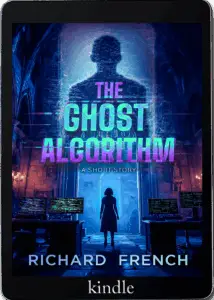
To read the rest of The Ghost Algorithm short story, please download the eBook from Amazon or receive all 5 short stories free when you join the newsletter email list.
