
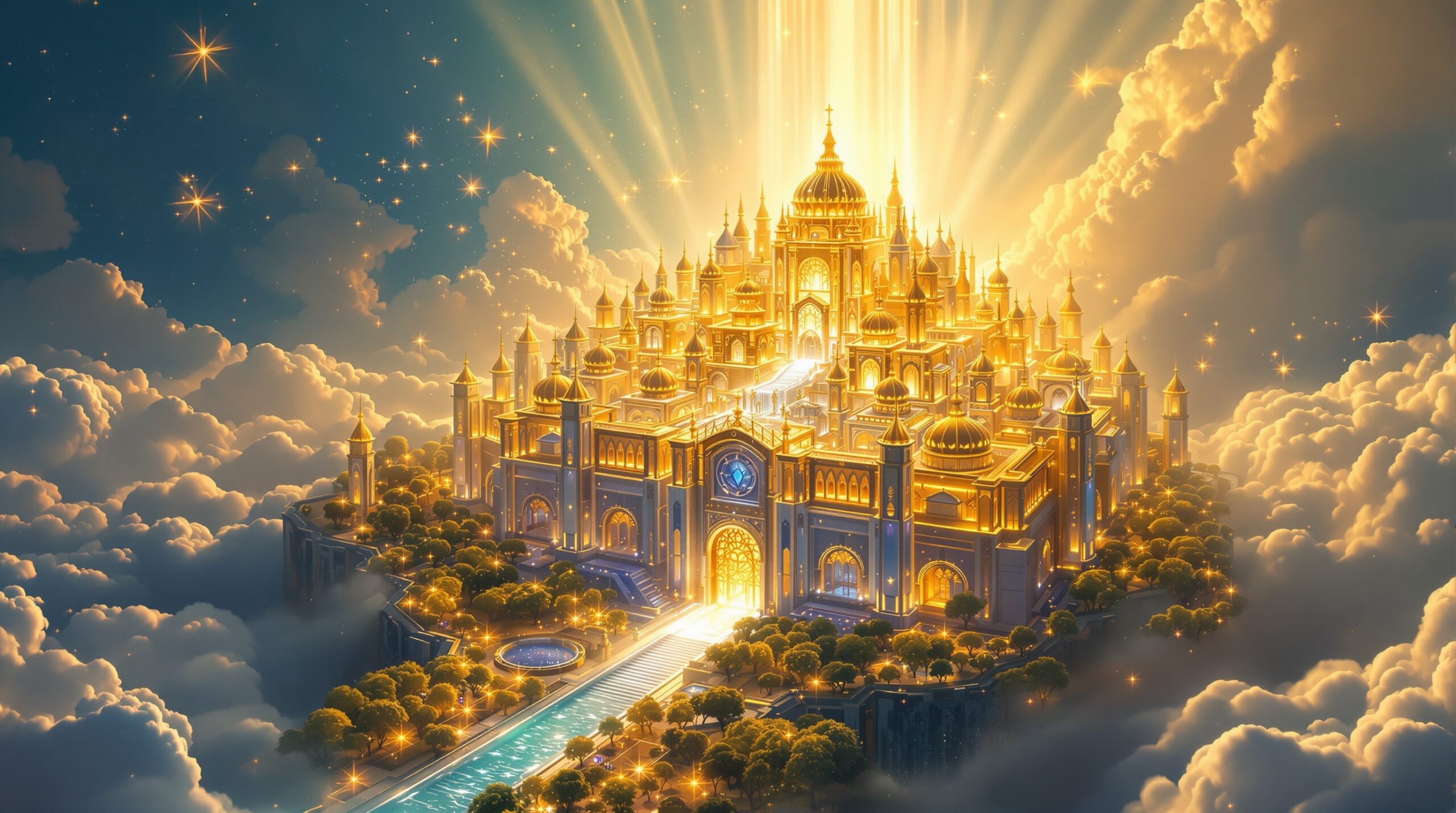
According to a 2021 Pew Research study, 73% of Americans believe in heaven, yet most can’t describe what Scripture actually teaches about eternity. When asked about streets of gold or the New Jerusalem, most Christians draw a blank or rely on vague cultural references rather than biblical text. This gap between belief and understanding matters more than you might think.
The book of Revelation provides specific, detailed answers about the New Jerusalem that go far beyond golden streets. John’s vision in chapters 21-22 describes exact dimensions, materials, and most importantly, the complete transformation of creation itself. Having studied Revelation verse by verse, I’ve learned that the clearest picture of eternity comes directly from Scripture, not from speculation or cultural Christianity. What God reveals about the New Jerusalem changes how we think about heaven, earth, and our eternal future.
BEFORE YOU READ FURTHER:
This article provides a solid overview of the New Jerusalem as described in Revelation 21-22, but a blog post has natural limits. For comprehensive understanding including verse-by-verse analysis of all 404 verses in Revelation, Old Testament connections, and the complete prophetic timeline placing the New Jerusalem in proper context, “Revelation Explained: Verse by Verse” offers systematic study that connects every symbol to its biblical source. Get the complete guide now or download the free sample chapter.
Now, let’s examine what Revelation actually says about the holy city.
Key Takeaways
- The New Jerusalem is a literal city that descends from heaven to the new earth after God recreates the entire universe (Revelation 21:1-2)
- The city measures 12,000 stadia (approximately 1,400 miles) in length, width, and height, forming a perfect cube that symbolizes divine perfection (Revelation 21:15-17)
- God Himself dwells directly with His people in the New Jerusalem with no temple required because He is the temple (Revelation 21:22)
- The city’s foundations contain twelve precious stones representing the twelve apostles, while the twelve gates bear the names of the twelve tribes of Israel (Revelation 21:12-14)
- No sun or moon lights the city because the glory of God and the Lamb provide constant illumination (Revelation 21:23)
- Only those whose names are written in the Lamb’s Book of Life will enter the holy city (Revelation 21:27)
- The river of life and tree of life flow through the city, symbolizing the restoration of what was lost in Eden (Revelation 22:1-2)
What Does Revelation Say About the New Jerusalem?
Revelation 21:1-2 opens with the most dramatic scene in Scripture: “Then I saw a new heaven and a new earth, for the first heaven and the first earth had passed away, and there was no longer any sea. I saw the Holy City, the new Jerusalem, coming down out of heaven from God, prepared as a bride beautifully dressed for her husband.”
Notice what John sees first. God doesn’t renovate the current creation. He makes something entirely new. The old heaven and earth pass away completely, replaced by a new creation free from sin’s effects. The absence of the sea carries symbolic weight because ancient cultures viewed the sea as representing chaos and danger. The new creation eliminates these threats entirely.
Then John sees the New Jerusalem descending. This detail matters because it shows the city’s origin. The New Jerusalem doesn’t rise from earth through human effort. It comes down from heaven, prepared by God Himself. The bridal imagery emphasizes the intimate relationship between Christ and His Church, now fully realized.
The Divine Promise: God Dwelling With Humanity
Revelation 21:3-4 reveals the central promise: “And I heard a loud voice from the throne saying, ‘Look! God’s dwelling place is now among the people, and He will dwell with them. They will be His people, and God Himself will be with them and be their God. He will wipe every tear from their eyes. There will be no more death or mourning or crying or pain, for the old order of things has passed away.'”
This passage fulfills the covenant promise repeated throughout Scripture (Leviticus 26:12, Jeremiah 31:33). God has always intended to dwell among His people. Sin created separation. The New Jerusalem removes that barrier forever.
The elimination of tears, death, mourning, crying, and pain represents more than comfort. It signals the complete reversal of the curse pronounced in Genesis 3. Every consequence of sin disappears in the new creation. Death itself dies.
Who Inherits the New Jerusalem?
Revelation 21:7-8 provides clear criteria: “Those who are victorious will inherit all this, and I will be their God and they will be my children. But the cowardly, the unbelieving, the vile, the murderers, the sexually immoral, those who practice magic arts, the idolaters and all liars—they will be consigned to the fiery lake of burning sulfur. This is the second death.”
The victorious are those who persevere in faith through trials. Their victory comes through Christ, not their own strength. God adopts them as His children, completing the relationship promised throughout Scripture (Romans 8:15-17).
The second group faces the second death in the lake of fire. This stark contrast shows the ultimate consequences of rejecting God. While God’s mercy extends to all who turn to Him, His justice requires accountability.
The New Jerusalem’s Structure and Dimensions
An angel shows John the city’s detailed specifications in Revelation 21:9-17. Understanding these details reveals God’s intentional design.
The holy city measures 12,000 stadia in length, width, and height. Converting to modern measurements, that’s approximately 1,400 miles in each direction. To put this in perspective, the distance from Maine to Florida is about 1,500 miles. The New Jerusalem would be visible from incredible distances.
More significant than the size is the shape. The city forms a perfect cube. Only one structure in Israel’s history shared this shape: the Holy of Holies in Solomon’s temple (1 Kings 6:20). The entire New Jerusalem becomes what the Holy of Holies represented—the dwelling place of God’s presence.
The wall measures 144 cubits thick (approximately 216 feet). While this might seem modest compared to the city’s overall size, the symbolism matters more than the proportion. The number 144 (12 x 12) represents the people of God multiplied—the twelve tribes of Israel and the twelve apostles united.
THE TWELVE GATES AND FOUNDATIONS:
Revelation 21:12-14 describes twelve gates bearing the names of Israel’s twelve tribes, with twelve foundations inscribed with the apostles’ names. This architectural detail reveals profound theological truth about God’s unified plan of salvation.
The gates represent access to the city. Naming them after Israel’s tribes acknowledges God’s covenant with His chosen people throughout the Old Testament. The foundations bearing the apostles’ names establish the New Covenant Church. Together, they demonstrate that God’s salvation plan encompasses all His people across all time. The Old and New Covenants aren’t separate plans but unified stages of God’s redemptive work culminating in the New Jerusalem.
Three gates face each direction—east, north, south, and west—symbolizing that salvation comes to people from every corner of the earth, fulfilling Isaiah’s prophecy that salvation would reach to the ends of the earth (Isaiah 49:6).
Materials That Reveal Spiritual Reality
Revelation 21:18-21 catalogs the city’s materials: “The wall was made of jasper, and the city of pure gold, as pure as glass. The foundations of the city walls were decorated with every kind of precious stone. The first foundation was jasper, the second sapphire, the third agate, the fourth emerald, the fifth onyx, the sixth ruby, the seventh chrysolite, the eighth beryl, the ninth topaz, the tenth turquoise, the eleventh jacinth, and the twelfth amethyst. The twelve gates were twelve pearls, each gate made of a single pearl. The great street of the city was of gold, as pure as transparent glass.”
These materials aren’t meant to impress with wealth alone. Each element carries spiritual significance. The jasper represents God’s glory (Revelation 4:3). The variety of precious stones reflects the diversity of God’s people unified in beauty. The single pearls forming entire gates speak to the single means of salvation—Christ’s work on the cross.
Gold so pure it becomes transparent symbolizes the complete holiness of the city. No impurity exists. Everything reflects God’s perfect nature.
No Temple Required
Revelation 21:22 contains a surprising statement: “I did not see a temple in the city, because the Lord God Almighty and the Lamb are its temple.”
Throughout Israel’s history, the temple represented God’s presence among His people. The tabernacle and later Solomon’s temple provided a designated place where God met with humanity. The New Jerusalem needs no temple because God’s presence fills the entire city. The distance that required a temple disappears.
This fulfills what the temple always pointed toward—direct fellowship with God. Believers no longer approach God through a building. They live in His presence constantly.
Light Without Sun or Moon
Revelation 21:23-25 describes the city’s illumination: “The city does not need the sun or the moon to shine on it, for the glory of God gives it light, and the Lamb is its lamp. The nations will walk by its light, and the kings of the earth will bring their splendor into it. On no day will its gates ever be shut, for there will be no night there.”
God’s glory provides the light. This connects to passages throughout Scripture where God’s presence appears as brilliant light (Exodus 34:29-35). The Lamb, Jesus Christ, serves as the lamp, emphasizing His role in illuminating the eternal city.
The absence of night carries practical and symbolic meaning. Ancient cities closed their gates at night for protection against enemies. The New Jerusalem’s gates remain perpetually open because no threat exists. The constant light represents the constant presence of God—no darkness, no separation, no fear.
THE RIVER OF LIFE AND TREE OF LIFE:
Revelation 22:1-2 brings the narrative full circle: “Then the angel showed me the river of the water of life, as clear as crystal, flowing from the throne of God and of the Lamb. On each side of the river stood the tree of life, bearing twelve crops of fruit, yielding its fruit every month. And the leaves of the tree are for the healing of the nations.”
These images deliberately echo Eden. Genesis 2 describes a river flowing through the garden and the tree of life. Sin blocked access to both. The New Jerusalem restores what was lost, but with significant enhancement. The river now flows directly from God’s throne, and the tree produces fruit continuously—twelve crops annually, one each month.
The phrase “healing of the nations” doesn’t imply ongoing sickness requiring treatment. Rather, it indicates the complete wholeness and well-being of all peoples. The Greek word for “healing” (therapeia) can mean health and vitality, not just recovery from illness. The leaves promote the flourishing of the nations in perfect harmony.
Who Enters the New Jerusalem?
Revelation 21:27 provides explicit criteria: “Nothing impure will ever enter it, nor will anyone who does what is shameful or deceitful, but only those whose names are written in the Lamb’s book of life.”
This verse functions as both warning and promise. The New Jerusalem maintains absolute purity and holiness. No sin enters. No shame. No deception. Only those redeemed by Christ—those whose names appear in the Lamb’s Book of Life—will dwell in the eternal city.
This exclusivity isn’t arbitrary. It reflects the reality that sin and holiness cannot coexist. God’s perfect dwelling place requires perfect holiness, which comes only through Christ’s redemptive work.
The warning applies to those who persist in rebellion against God. The promise extends to all who turn to Christ in faith. The Book of Life records every person who trusts in Jesus for salvation.
Understanding the Complete Picture
This post covered the essential details about the New Jerusalem from Revelation 21-22, but these chapters contain additional critical information: the river of life’s continuous flow, Christ’s final warnings about Scripture, and the invitation to “take the free gift of the water of life” (Revelation 22:17).
The New Jerusalem represents the culmination of God’s entire redemptive plan spanning all of Scripture. It connects to the Garden of Eden, fulfills Old Testament prophecies from Isaiah and Ezekiel, and completes the New Testament promise of Christ’s return. Understanding the complete prophetic timeline requires seeing how the New Jerusalem relates to the Millennium, the Great White Throne Judgment, and the defeat of Satan.
How does the New Jerusalem differ from the Millennial Kingdom? What happens between Christ’s Second Coming and the descent of the holy city? Why does God create a new heaven and earth rather than renovating the current creation?
For those seeking comprehensive understanding, “Revelation Explained: Verse by Verse” by Richard French provides systematic analysis of all 404 verses, connecting every symbol to its Old Testament source and placing each event in proper chronological sequence. The verse-by-verse approach allows you to verify every interpretation with your own Bible study. Get the complete guide or download the free sample chapter.
Frequently Asked Questions
How big is the New Jerusalem?
The New Jerusalem measures 12,000 stadia in length, width, and height (Revelation 21:16). Converting to modern measurements, this equals approximately 1,400 miles in each direction, forming a perfect cube. This enormous size would be visible from incredible distances and could easily accommodate all believers throughout history. The cubic shape mirrors the Holy of Holies in Solomon’s temple, symbolizing that the entire city becomes God’s dwelling place where His presence fills everything.
Will there be marriage in the New Jerusalem?
Jesus explained that in the resurrection, people “will neither marry nor be given in marriage” (Matthew 22:30). Marriage serves as a temporary earthly institution that points to the greater reality of Christ’s relationship with His Church. In the New Jerusalem, believers experience the perfect union with Christ that marriage only foreshadowed. The absence of marriage doesn’t represent loss but rather fulfillment of what marriage always symbolized—intimate, eternal communion with God Himself.
What are the streets of gold in the New Jerusalem?
Revelation 21:21 describes “the great street of the city was of gold, as pure as transparent glass.” The gold isn’t opaque like earthly gold but transparent, symbolizing absolute purity and holiness. The streets represent the common pathways of daily life in the eternal city, indicating that even ordinary elements in God’s presence possess extraordinary beauty. The transparent quality suggests that nothing hides in the New Jerusalem—everything exists in perfect openness and purity before God.
Is the New Jerusalem the same as heaven?
The New Jerusalem descends from heaven to the new earth (Revelation 21:2), making it distinct from the current heaven where believers go when they die. When Scripture speaks of believers going “to heaven,” it refers to the intermediate state between death and resurrection. The New Jerusalem represents the final eternal state where heaven and earth unite. God creates a new heaven and new earth, and the New Jerusalem becomes the place where God dwells with His people on the renewed earth forever.
Who will live in the New Jerusalem?
Revelation 21:27 states that only those whose names are written in the Lamb’s Book of Life will enter the New Jerusalem. This includes all believers throughout history who trusted in Christ for salvation—both Old Testament saints who looked forward to the Messiah and New Testament believers who trust in Jesus. The city’s gates bearing the names of Israel’s twelve tribes and foundations inscribed with the apostles’ names symbolize that God’s unified people from all ages will dwell there together in perfect fellowship with Him.
The vision of the New Jerusalem offers believers concrete hope grounded in God’s specific promises. When you face suffering or loss today, remember that God is preparing a place where He wipes away every tear. That future isn’t wishful thinking—it’s the guaranteed destination for everyone whose name appears in the Lamb’s Book of Life.
