
What Joseph’s Story Teaches Us About the Long Middle
- Richard French
Joseph’s life does not move from hardship to triumph overnight. Its deepest comfort is found in the years between the two: the seasons of waiting, uncertainty, and quiet faithfulness.
Quick Answer: Joseph’s story teaches that the long years of waiting between hardship and rescue are not wasted. Genesis repeats “the LORD was with Joseph” while he is a slave and a prisoner, not only after he rises to power.
Key Fact: Joseph was seventeen when his brothers sold him (Genesis 37:2) and thirty when he stood before Pharaoh (Genesis 41:46), about thirteen years between the pit and the palace.
Context: Genesis 39 to 41 covers those years in Potiphar’s house and in prison, the long middle of Joseph’s story.
The part of the story we usually skip
Most retellings of Joseph’s life move quickly between the memorable scenes. The coat appears, the pit follows, and suddenly Joseph is standing before Pharaoh. But Genesis gives weight to the years in between. Joseph is sold, carried to a foreign land, placed in another man’s household, falsely accused, and forgotten in prison. His rise is dramatic, but the waiting is where his character is tested.
That long middle matters because it is where the story’s quiet refrain becomes visible: “the LORD was with Joseph.” The words do not appear only when Joseph is successful. They accompany him in slavery and in confinement. The presence of God is not measured by Joseph’s comfort, status, or immediate prospects. Joseph is not abandoned in slavery simply because the next chapter has not arrived.
Faithfulness before recognition
Joseph continues to serve well when no one is celebrating him. In Potiphar’s house, responsibility grows because he can be trusted. In prison, he notices the distress of others and offers help. Even when the cupbearer forgets him, Joseph’s earlier faithfulness has not become meaningless. The story reminds us that a life can be forming long before anyone sees its purpose.
This is one reason Joseph feels so familiar. Many people know what it is to work faithfully without receiving an explanation, to endure a season that seems unfair, or to wonder whether forgotten years count for anything. Joseph’s experience does not provide a simple formula for escaping hardship. It offers something steadier: hardship is not proof that God is absent.
Providence without pretending
The story also refuses to call evil good. Joseph’s brothers act out of jealousy. He is genuinely harmed. Years later, when Joseph tells them that God meant their evil for good, he does not deny what they did. He names it clearly. Providence does not erase responsibility; it shows that wrongdoing does not have the final word.
That distinction makes forgiveness possible. Joseph can release vengeance without pretending the betrayal was harmless. He can see the lives preserved through his position in Egypt while still remembering the road that brought him there.
A story for patient readers
The Story of Joseph tells this entire arc in fifteen accessible parts, allowing readers to experience not only the spectacular turns but also the patient movement between them. Read quickly, it is a compelling narrative. Read slowly, it becomes a companion for seasons when the outcome is still hidden.
Joseph’s story asks us to look again at the years we might call wasted. What if faithfulness is being built there? What if presence can be real before purpose becomes clear? And what if the long middle is not empty space, but part of the story?
Read the whole story
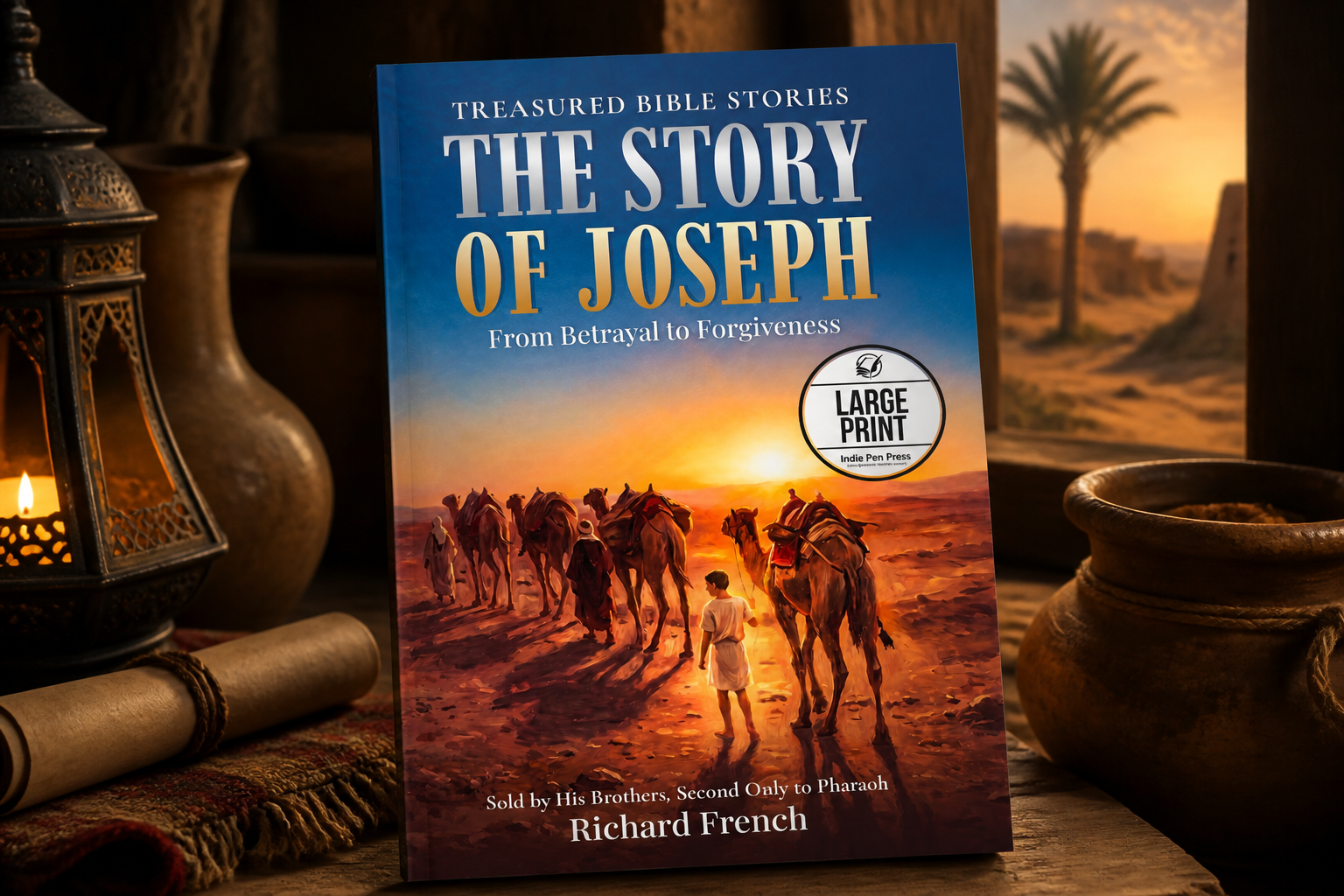
The Story of Joseph: From Betrayal to Forgiveness tells Genesis 37 to 50 as one story in fifteen parts, written for adult readers. It is book 1 of my Treasured Bible Stories series.
- Indie Pen Press store: ebook now, large print paperback from October 14
- Amazon Kindle: The Story of Joseph, Kindle edition
- Amazon paperback: The Story of Joseph, large print paperback (from October 14)
As an Amazon Associate, I earn from qualifying purchases.
Frequently Asked Questions
What does “the LORD was with Joseph” mean in Genesis 39?
The phrase appears while Joseph is a slave in Potiphar’s house (Genesis 39:2) and again while he is in prison (Genesis 39:21). Genesis places God’s presence with Joseph in his lowest seasons, not only after his rise to power.
How long was Joseph a slave and a prisoner?
About thirteen years. Joseph was seventeen when his brothers sold him (Genesis 37:2) and thirty when he entered Pharaoh’s service (Genesis 41:46). At least two full years of that time came after the cupbearer forgot him (Genesis 41:1).
Did Joseph excuse what his brothers did to him?
No. In Genesis 50:20 he tells them, “you meant evil against me, but God meant it for good.” He names their act as evil while recognizing God’s purpose in what followed.
What is The Story of Joseph by Richard French?
It is a retelling of Genesis 37 to 50 for adult readers, told as one story in fifteen parts. It is book 1 of the Treasured Bible Stories series, available as a Kindle ebook and a large print paperback.